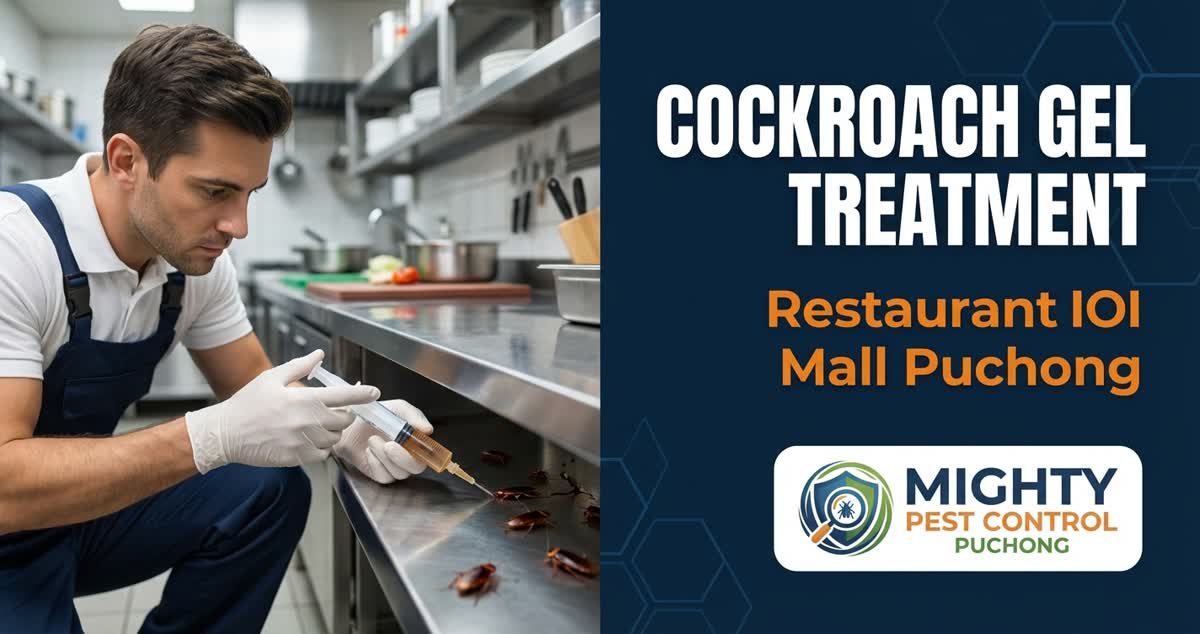
The Challenge
The owner of a popular restaurant near IOI Mall Puchong contacted us after a routine health inspection flagged a significant cockroach issue in the kitchen. Staff had been seeing German cockroaches (Blattella germanica) daily, particularly around the dishwashing area, behind cooking ranges, and inside electrical junction boxes.
The restaurant had been using over-the-counter spray cans from the hardware store. While these provided temporary relief — killing visible cockroaches on contact — the population kept rebounding within days. The previous pest control vendor had been applying general-purpose residual spray monthly, but with minimal lasting impact.
The issue was urgent. Another failed health inspection could result in a closure notice, and customer complaints about pest sightings were starting to appear on Google reviews.
Our Assessment
We conducted a thorough inspection during the restaurant's closing hours. Our team used flushing agents and sticky monitoring traps to assess the infestation level. Key findings:
- Severe infestation behind the main cooking range — hundreds of cockroaches in various life stages, including egg cases (oothecae)
- Heavy harbourage inside the motor housing of the walk-in chiller and behind the dishwasher
- Moderate activity in the dry store area, particularly around cardboard storage boxes
- Entry points identified: gaps around drain pipes, a cracked floor trap, and cable entry holes in the wall
- Contributing factors: grease buildup behind equipment, food debris in hard-to-reach areas, and cardboard boxes stored directly on the floor
The species was confirmed as German cockroach — the most challenging kitchen pest due to its rapid breeding cycle (a single female can produce up to 300 offspring in her lifetime) and resistance to many common insecticides.
The Treatment Plan
Phase 1: Deep Clean Coordination
Before any chemical treatment, we coordinated with the restaurant's cleaning team for a thorough deep clean of the kitchen. Grease was stripped from behind all cooking equipment, floor drains were flushed and cleaned, and all cardboard boxes were replaced with plastic storage bins. This step is non-negotiable — no amount of chemical treatment will control cockroaches in a kitchen that provides unlimited food and harbourage.
Phase 2: Gel Baiting with Advion
We applied Advion cockroach gel bait at over 80 placement points throughout the kitchen. Gel was applied in small dots (pea-sized) in cracks, crevices, hinges, behind equipment mounting brackets, inside electrical boxes, and along pipe runs. The placement strategy focused on areas of highest activity identified during the inspection.
Advion's active ingredient (indoxacarb) works through a cascade effect. Cockroaches that feed on the bait die within 24-48 hours. Other cockroaches that feed on the dead insects or their faeces also receive a lethal dose. This secondary kill effect is what makes gel baiting so effective against large populations — it reaches cockroaches that never directly contact the bait.
Phase 3: Targeted Residual Spray
We applied a micro-encapsulated residual insecticide to non-food-contact areas: along external perimeter walls, around drain openings, cable entry points, and the loading dock doorway. This created a chemical barrier to prevent reinfestation from adjacent premises — a common problem for restaurants in shophouse rows.
Phase 4: Entry Point Sealing
Our team sealed identified entry points using food-grade silicone sealant around pipe penetrations and stainless steel mesh over cable entry holes. The cracked floor trap was reported to the building management for replacement.
Results
- Week 1: Monitoring traps showed 70% reduction in cockroach activity. Staff reported significantly fewer sightings during operating hours
- Week 2: 85% reduction. Dead cockroaches found in back-of-house areas — evidence of the cascade effect working through the population
- Week 3: 95% reduction. Only occasional single sightings near the external loading area
- Week 6: Follow-up gel reapplication. Monitoring traps showing near-zero activity
✅ Project Results
- 95% cockroach population reduction within 3 weeks
- Passed subsequent health inspection with clean report
- Zero cockroach-related customer complaints since treatment
- Restaurant enrolled in bi-monthly maintenance programme
- Staff trained on sanitation practices that support long-term control
Why Gel Baiting Outperforms Spraying for Kitchens
Traditional spray-only approaches fail in commercial kitchens for several reasons. Sprays are repellent — cockroaches learn to avoid treated surfaces. Sprays also break down quickly in the heat and grease of a working kitchen. And spray residues on food-contact surfaces create compliance risks during health inspections.
Gel baiting is a fundamentally different approach. It's attractive rather than repellent, so cockroaches seek it out. It's applied in concealed locations away from food. And the cascade killing effect means it reaches the hidden majority of the population — not just the few cockroaches you see running across the floor.
Cockroach Problems in Your Restaurant?
We specialise in F&B pest control across Puchong. Discreet, effective treatments that work around your operating hours.
📱 WhatsApp Us for Emergency TreatmentOr call 03-6096 0068